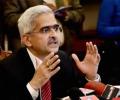
Experts disagree with the idea and the Reserve Bank of India (RBI), which has the sole right to print money, is not comfortable with it as well.

'It would be reasonable to assume that Modi 3.0 would be more focused on projects and schemes which do not require any legislative change or which have the support of its coalition partners,' asserts A K Bhattacharya.
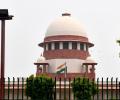
The Supreme Court on Monday referred to a five-judge Constitution bench a suit filed by the Kerala government raising the issue of ceiling on net borrowing.
The Reserve Bank of India on Thursday projected a GDP growth of 7 per cent for 2024-25 financial year, which is lower than the 7.3 per cent expansion estimated for the current fiscal. Announcing the bi-monthly monetary policy, RBI Governor Shaktikanta Das said rural demand continues to gather pace, urban consumption remains strong and investment cycle is gaining steam on the back of increased capex.

The finance minister continues to be backed by the same policy team in charting out the broad strategy as in the few earlier Budgets.
The Reserve Bank of India on Friday raised the GDP growth projection for the current fiscal to 7 per cent from 6.5 per cent earlier on buoyant domestic demand and higher capacity utilisation in the manufacturing sector. Announcing the bi-monthly monetary policy, RBI Governor Shaktikanta Das, however, flagged protracted geopolitical turmoil and global economic fragmentation as risks to the growth outlook. The RBI kept interest rates unchanged at 6.5 per cent in Friday's monetary policy statement.

'Like every Budget, this time, too, there is chatter around tinkering with the long-term capital gains tax.' 'Investors may not want to jump into the markets until there is clarity on this front.'

India's rank in the World Bank's ease of doing business index cannot get better unless more attention is paid to bringing about procedural reforms in the way states run their governments and provide various approvals for trade and industry, says A K Bhattacharya.
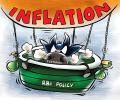
The Reserve Bank of India on Friday retained its projection for retail inflation at 4.5 per cent for the current fiscal assuming a normal monsoon, while emphasising that uncertainties related to food price outlook warrant a close monitoring. Consumer Price Index (CPI)-based retail inflation has been projected at 4.5 per cent with quarter-wise projections at 4.9 per cent in Q1 (April-June), 3.8 per cent in Q2, 4.6 per cent in Q3, and 4.5 per cent in Q4.

The wholesale inflation rose to a 13-month high of 1.26 per cent in April fuelled by rising prices of food articles, especially vegetables, amid expectations of RBI holding interest rates in the policy review next month. The wholesale price index (WPI) based inflation has been rising for two months in a row.

In the midst of third wave of COVID-19, Finance Minister Nirmala Sitharaman has come up with an impactful Budget which is balanced, fiscally prudent and growth-oriented, the USA India Chamber of Commerce has said. President of the Boston-based USA India Chamber of Commerce (USAIC) Karun Rishi, however, said it is a matter of concern that the budget lacks tangible measures to increase revenue generation. "Opting to keep the fiscal deficit at 6.9 per cent and increase capital expenditure by 35 per cent is a masterstroke. "The annual budget estimates the effective capital expenditure of Rs 10.68 lakh crore in 2022-23, making up about 4.1 per cent of the GDP," he said. "A phenomenal increase in the government's capital expenditure is likely to facilitate the expenditures on infrastructure and create jobs.
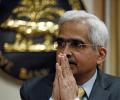
Monetary Policy Committee keeps key interest rate (repo) unchanged at 4% for 7th consecutive time; Consequently, reverse repo rate too remains unchanged at 3.35%; Bank rate also remains same at 4.25%;

Rating agency Fitch on Tuesday downgraded the US government's top credit rating to AA+ from AAA, citing fiscal deterioration over the next three years and repeated debt ceiling negotiations. The development caused a flutter across equity markets, with most leading frontline global equity indices trading weak. Back home, the S&P BSE Sensex and the Nifty50 lost over 1 per cent each in intra-day deals to hit a low of 65,751.53 and 19,517.55 levels, respectively.

Nirmala Sitharaman on Wednesday assumed charge as the Finance and Corporate Affairs Minister for the second consecutive term and is slated to soon present the final Budget for FY '25 that is going to set the tone for the Modi 3.0 government's priorities and direction for Viksit Bharat. Upon her reaching the North Block office, Sitharaman was greeted by Finance Secretary T V Somanathan and other top officials. Minister of State for Finance Pankaj Chaudhary was also present. Chaudhary assumed charge on Tuesday evening.

'Compare the new slabs with the previous years to understand if your tax liability will increase or decrease after the Budget.'

Release of key macroeconomic numbers, monthly derivatives expiry, and global cues are likely to drive stock market movement this week, according to analysts. Markets will also be reacting to remarks made by the US Federal Reserve Chair Jerome Powell, they said. "This week, we expect the market to witness a gradual up-move with stock-specific action.

Withdrawing a blanket ban on overseas shipments of non-basmati white rice, the government on Saturday imposed a floor price of $490 per tonne and exempted the commodity from export duty. Exports of non-basmati white rice have been banned since July 20, 2023 to boost domestic supply. "The export policy for non-basmati white rice (semi-milled or wholly milled rice, whether or not polished or gazed) ...is amended from prohibited to free, subject to MEP (minimum export price) of $490 per tonne with immediate effect and until further orders," the directorate general of foreign trade (DGFT) said in a notification.

Finance Minister Nirmala Sitharaman on Wednesday said the country's economic growth remains a priority for the government, as inflation has come down to a manageable level. Job creation and equitable distribution of wealth remain the other focus areas, she said at India Ideas Summit. "Some of course are red-lettered (priorities), some may not be. Red-lettered ones would of course be jobs, equitable wealth distribution and making sure India is moving on the path of growth.
The Reserve Bank on Friday retained inflation projection at 4.5 per cent for the current financial year, lower than 5.4 per cent in the last fiscal. Assuming a normal monsoon this year, CPI (consumer price index-based) inflation for the current year is projected at 4.5 per cent, with Q1 at 4.9 per cent, Q2 at 3.8 per cent, Q3 at 4.6 per cent, and Q4 at 4.5 per cent.

The government has spent a little less than one-third of the Budget estimate of capital expenditure, it can still spend about Rs 20,000 crore this year without disturbing its fiscal deficit target.

'The problem is that the bubble may not only be in valuations, but also in investors' minds.'
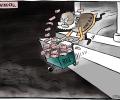
The government has already crossed the fiscal deficit at 132 per cent of the estimate as of December end.

'If the government spends Rs 10 lakh crore this year then you would be looking at a GDP growth of minus 5 per cent.' 'If you do not do this, you will be looking at GDP growth between minus nine and minus 10 per cent.'

Consensus remained elusive on a common BRICS currency as business leaders from the five-bloc nations debated the pivotal issue at a business forum on the periphery of a summit of the five-member bloc being hosted here by South Africa. In their two addresses at the Summit so far, the leaders of Brazil, Russia, India, China and South Africa have made no or scant references to the issue either. "The BRICS Business Forum discussed the international payments system in detail. "Participants also debated the question of whether a BRICS currency is possible or desirable, with strong views expressed both for and against and little consensus reached," Sim Tshabalala, chief executive of Standard Bank Group, told several hundred captains of industry from the partner countries and over 40 other nations across the globe at the Summit.

'Invest only in stocks of those companies that deliver on earnings and there is earnings visibility too for the next few quarters.'

The government is expected to defer the mega initial public offering (IPO) of LIC to the next financial year as the ongoing Russia-Ukraine war has dampened fund managers' interest in the public issue, market experts said on Sunday. The government was looking to sell 5 per cent stake in Life Insurance Corporation (LIC) this month, which could have fetched over Rs 60,000 crore to the exchequer. The IPO would have helped meet the curtailed divestment target of Rs 78,000 crore this fiscal.

The Reserve Bank of India on Thursday kept the benchmark interest rate unchanged at 4 per cent and decided to continue with its accommodative stance against the backdrop of an elevated level of inflation.

The BJP losing its outright majority and relying on allies to form a government could pose challenges for the more ambitious elements of reform agenda like land and labour, Fitch Ratings said in a note on Wednesday. Prime Minister Narendra Modi-led BJP lost its majority for the first time since 2014, winning 240 seats in the 543-seat Lok Sabha.

S&P Global Ratings on Thursday cut India's growth forecast for the current fiscal to 9.5 per cent, from 11 per cent earlier, and warned of risk to the outlook from further waves of COVID pandemic. The agency lowered the growth outlook saying that a severe second COVID-19 outbreak in April and May led to lockdowns imposed by states and sharp contraction in economic activity. "We forecast growth of 9.5 per cent this fiscal year from our March forecast of 11 per cent," S&P said.

Many who track the ministry and the technology sector closely believe that the space won't see much impact on the policymaking side, but the gestation time for regulations might get long, as now there could be a wider consensus-building exercise on policy matters under a coalition government.

Passenger vehicle wholesales in India touched a record high of 42,18,746 units in the financial year 2023-24, registering a year-on-year growth of 8.4 per cent on the back of robust demand for utility vehicles, industry body SIAM said on Friday. As per the latest data issued by the Society of Indian Automobile Manufacturers (SIAM), the overall passenger vehicle dispatches stood at 38,90,114 units in fiscal year 2022-23. Two-wheeler sales were up 13.3 per cent last fiscal at 1,79,74,365 units, as compared to 1,58,62,771 units in the financial year 2022-23.

Xi Jinping's recent actions in South Asia have amply demonstrated the disastrous impact of China's embrace, observes Jayadeva Ranade, the retired senior RA&W officer and China expert.

The United Nations on Wednesday pared down India's growth forecast by 20 basis points to 5.8 per cent for 2023 calendar year, citing higher interest rates and risks of recession in the developed world weighing on investment and exports. "Economic growth in India is projected to moderate in 2023, with higher interest rates weighing on investment and slower global growth weakening exports," it said in its latest World Economic Situation and Prospects report. The report has projected global trade to contract 0.4 per cent and the world economy to grow at 1.9 per cent in 2023.

Swiss brokerage Credit Suisse expects the economy to continue to show positive surprises and record up to 9 per cent growth in the next fiscal. For the current financial year too, the brokerage anticipates growth to be higher than the consensus forecast of 8.4-9.5 per cent, and printing in at around 10.5 per cent. As a policy, Credit Suisse does not provide absolute growth numbers in its forecast.

'The private sector believes that some enablers in labour-intensive sectors like apparel, toys, tourism, and media retail, can unlock a lot of jobs.'
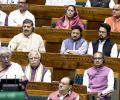
Finance Minister Nirmala Sitharaman on Tuesday announced income tax relief for the middle class, a Rs 2 lakh crore outlay for job creation schemes over the next five years and a spending splurge for states run by her party's new coalition partners as she unveiled the Modi 3.0 government's first budget after the general elections.

'The BJP's numbers in this government are almost the same as those enjoyed by the Congress under P V Narasimha Rao when the reform process was kicked off in 1991.' 'As before, the only constraints on the prime minister's actions are internal, not external.' 'They come from his own assessment of the political consequences of any action,' points out Mihir S Sharma.

The Reserve Bank of India on Friday revised upwards the GDP growth projection for the current fiscal to 7.2 per cent from 7 per cent on rising private consumption and revival of demand in rural areas. Unveiling the bi-monthly monetary policy, RBI Governor Shaktikanta Das said estimates released by the National Statistical Office (NSO) placed India's real gross domestic product (GDP) growth at 8.2 per cent in 2023-24. "During 2024-25 so far, domestic economic activity has maintained resilience," he said, adding that manufacturing activity continues to gain ground on the back of strengthening domestic demand.

IT and interest rate-sensitive bank, realty, and auto stocks ended with sharp gains.
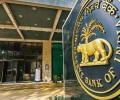
The Reserve Bank of India's rate-setting panel on Wednesday started discussions to firm up the next bi-monthly monetary policy amid expectations that it might retain status quo on interest rate but change its monetary policy stance amid rising inflation on account of geopolitical developments.
 © 2026 Rediff.com - Advertise with us - Disclaimer - Privacy Policy - Sitemap - Feedback - About us - Terms of use - Grievances